Scuba BCDs
Types and Styles of BC's With
Advantages and Disadvantages
When you go diving, scuba BCDs make your life alot easier. Without one, it'd be alot harder - if not impossible - to remain neutrally buoyant.
And just where would we put that tank anyway?
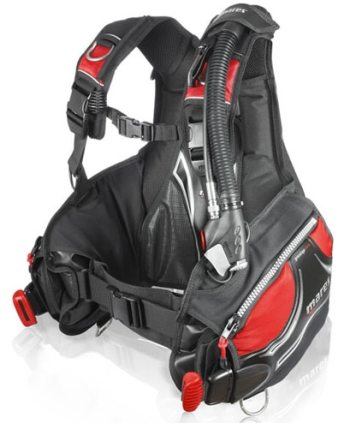
But just what is a scuba diving BC, what does it stand for and what types and styles are there out there?
Read on to find out.
Scuba BCDs Basics
OK, let's start with the basics. Just what does BCD stand for?
BCD is short for buoyancy control device, buoyancy compensator device or buoyancy compensation device.
It is also referred to as a BC which stands for buoyancy compensator.
Different names - same meaning. If you refer to it as any of the above, a diver will know what you mean.
Now that we know what it means, just what are scuba BCDs?
A scuba BCD is essentially just an air bladder that lets you control your buoyancy underwater (for a discussion on all the parts of a scuba dive bc, read our page on scuba BC parts.)
Your buoyancy will change as you descend in the water and/or use air in your tank.
It will also change with each dive if you change the amount of weight you are carrying, change the accessories your bring on a dive, etc.
You simply put more air into the bladder or take air out depending on if you want to be more or less buoyant. A very simple concept but an essential piece of scuba gear.
Besides controlling your bouyancy, scuba BCDs also store your dive accessories, keep your regulators and octopuses from dangling and even store your weights if it is a weight integrated BC.
Its' primary function, however, is as a device to help you control your buoyancy. (If you have trouble with your buoyancy, check out our page with buoyancy control scuba diving tips.)
Types of Scuba BCD's
There are essentially two types of scuba diving BCs in wide use today. They are the "jacket" or "vest" style and the "back-mounted" or "wings" style.
- Jacket or Vest Style BCDs
- Back Mounted or Wing Style
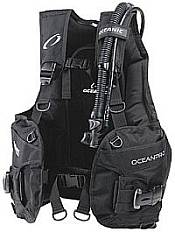
This is the most common BC type for warm water recreational diving. It is also the type that you were probably given to use when you got your scuba diving certification.
This style of BC for scuba diving is, as the name implies, like a vest or sleeveless jacket.
The air bladders wrap around the diver from the back to the front. The air bladder on my BC goes around the backplate and around the waist with the biggest portion of the air bladder located under the arms and along the side of my torso.
The jacket style of scuba BCDs is stabilizing and allows a diver to float vertically at the surface.
I find this style of scuba BCDs to be comfortable and easy to use. Perfect for a nice dive in the Caribbean during a scuba dive vacation.
This type of dive BC has the air bladders located on the back of the diver, on the sides of the tank.
Guess you could have guessed that from its' name.
One advantage of this style of BC is that the front of the diver is clear and the diver has more freedom of movement than in the jacket style BC.
Another advantage is lift capacity. The wing style BC typically has a larger lift capacity than the jacket style.
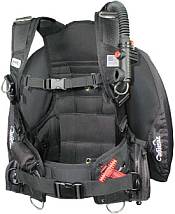
This type of BC can also be modular, meaning the diver can use the main harness and change out the back plates, air cells, etc.
This style is usually the choice for technical divers. Since they are usually carrying alot more weight than the rec, sightseeing diver, tech divers need more lift capacity.
If I were carrying 2 tanks and who-knows-what-else, I would want a BC with more lift capacity too.
The wing style BCD also tends to put the diver in a horizontal position since the bladders are on the back. This characteristic is popular with those divers who work in an overhead environment, swim on the surface alot, etc.
The feature of putting a diver facedown in a horizontal position is also the one most cited as a disadvantage of the back mounted scuba diving BC. In an emergency situation on the surface you would want the dive to be faceup.
I think there are advantages and disadvantages to both types of scuba BCDs. Which style you choose is a personal preference.
I will say that, in my experience, the jacket style BC is by far the most common for warm water recreational diving. I can probably count on one hand the times I have seen a diver using the back-mounted BC in over 15 years of diving in the Caribbean.
Not that this makes a back mounted style bad. Far from it. Just my observation.
Whichever style you choose, I hope you have a safe and comfortable dive.
For more information, you can check out our guide to diving BCs here, including our recommendations for best scuba diving BC.
Looking for other scuba equipment and accessories? Check out our picks for best scuba diving gear.
Want to stay down longer and improve your buoyancy control and other diving skills? Our free report "Increase Your Bottom Time" along with our practical, weekly actionable tips will have you looking like a seasoned diver in no time. So come join us and see improvement on your very next dive!
(Click on the photo to join us now!)

What's New


-
Unofficially Summer
May 25, 24 07:19 AM
Well it is finally here. Memorial Day weekend and the unofficial start of summer! Wishing everyone a happy and healthy holiday weekend. Hopefully the weather cooperates wherever you are and you will b… -
Happy New Year
Jan 01, 24 06:00 AM
Happy New Year everyone! I hope everyone is well and had a fun New Years Eve! May your new year be filled with lots of wonderful dives. All the best to you and yours in 2024! Let the dives begin. -
Happy Holidays
Dec 14, 23 05:05 AM
I hope everyone is enjoying the holiday season! I am always amazed at how fast time flies and another year is just around the corner. I wanted to pop in and say hi to everyone. I am doing some full ti… -
3 Common Scuba Diving Mistakes New Divers Make
Feb 23, 23 02:18 PM
 In this video, I share 3 common scuba diving mistakes beginner divers make. Learn how to correct these for a better - and safer - dive.
 -
Scuba Diving Tipping Etiquette: How Much And When To Tip Scuba Crew
Feb 06, 23 03:34 PM
Not sure of scuba diving tipping etiquette? In this video I share who to tip, when to tip, how much to tip, tipping on liveaboards, tipping an instructor & more

Click below to grab our free report and weekly actionable tips:

Popular Pages
 |
 |
 |
 |



New! Comments
Have your say about what you just read! Leave me a comment in the box below.