Buoyancy Control Scuba Diving Tips:
Keep Level and Achieve Neutral Buoyancy
If you are having trouble staying steady underwater, try these buoyancy control scuba diving tips.
It can be frustrating if you are always adding air or letting air out of your BC. We have all been there and can relate.
Fiddling with your BC can also take some of the pleasure out of the dive since you are preoccupied trying to stay at the proper depth. No to mention adversely affecting your air consumption.
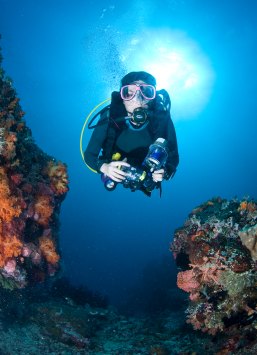
Looking neutrally buoyant in this picture. You can get there too.
If that's not enough for you, DAN (Divers Alert Network) states that "Diving incident reports often cite overweighting and/or poor buoyancy control as a contributory factor to, or a factor associated with, accidents or near accidents."
So what can you do improve your buoyancy control and get neutrally buoyant? Try these:
Buoyancy Control Scuba Diving Tips
- Use the Proper Weight
Most beginning scuba divers are overweighted. This will generally cause more use of the buoyancy compensator inflater as you change depth.
- If you are wearing a wetsuit you will also become less buoyant as you descend (see below). With these factors, the needed adjustments to your BC to maintain proper buoyancy are magnified.
So what is the proper weight? The most common answer is when you are on the surface, you should be at eye level with the water with no air in your BC.
However, this is with a full tank.
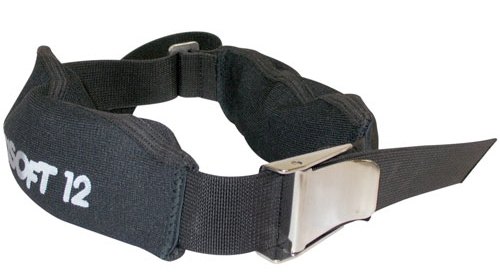
Using the proper amount of weight is key to buoyancy control.
As you use up your air, your scuba tank will become positively buoyant. This is especially important at your 15 foot safety stop because if you use the above method, you will be underweighted and will begin floating toward the surface.
If you can't get a near empty tank to test your buoyancy at the surface, you should be a little negatively buoyant at the surface with a full tank and no air in your BC and your lungs half-full.
This does not mean to put 5 extra lbs. on your weight belt. A safe bet is to put 1-2 lbs. extra on and go from there.
Your goal is to be neutrally buoyant at your 15 foot safety stop. This method is also cited in articles on DAN's website (Divers Alert Network, a non-profit organization that provides emergency medical advice and assistance for underwater diving injuries).
So at your safety stop with no air in your BC, if you are motionless (concentrate on that!) and you start ascending, your are underweighted. Conversely, if you are sinking, you are overweighted. Make adjustments in 1-2 lb. increments on your next dive.
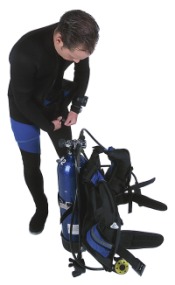
- Be Patient and Do it in Small Increments
- Remember the Effects of Your Wetsuit
- Empty Your BC
If you feel you are underweighted, make sure your BC is empty of all air. Sometimes air bubbles can get trapped inside, the effect of which will be magnified as you ascend.
If you add or release air from your BC, give it time to take effect. It will not be instantaneous. If you don't give it a bit of time, you will have the tendency to overinflate (or deflate). Several seconds should be sufficient.
Also, just give the BC a short shot (or release) of air. See if that is sufficient. If not, you can always add more. You do not want to overinflate - or vice-versa.
If you are wearing a scuba diving wetsuit, it will become less buoyant as you descend. As it becomes wet and the bubbles in the wetsuit compress from the pressure, the suit will lose buoyancy.
You may think you are underweighted at this point but wait until you a down for a bit before you decide - especially if you are unfamiliar with the affects of your wetsuit.
In addition, over time your wetsuit will lose some of its buoyancy as the bubbles break down. Unfortunately, it also means it will lose some of its insulation effectiveness.
Some buoyancy control tips to get the last of the air out of your BC:
- Hold the inflator hose straight up while pressing the release button.
- Do a little wiggle dance and see if any air escapes.(Hopefully no one will see you!)
- Hold the right side of your BC against your body and tilt a little to the right.
- Go upside down and pull the dump valve on the bottom of your BC.
- Roll backwards a little and give a little shake.
- Stay Horizontal
You should be horizontal in the water so your kicks propel you forward and not upward. You may have to adjust where your weights are to accomplish this. It is also a function of experience, so be patient. More buoyancy control scuba diving tips:
- Breath Control
- Dive, Dive and Dive Some More
Don't forget the air in your lungs. Do not hold your breath - which you know already. Besides being dangerous, it will give you extra buoyancy.
Eventually you will get to the point where you can ascend or descend a few feet solely by breathing in or out. Yes, it will happen. Which brings me to the last of the buoyancy control scuba diving tips:
Like all scuba diving skills, the more you practice them, the easier it will be. Once you get enough dives under your belt, relax under water and have experience with the weight you need, you will be diving without even giving scuba diving buoyancy a second thought.
Hopefully these buoyancy control tips will help you with any problems you may have. Believe it or not, after enough diving, you won't even be thinking about buoyancy control. So relax and enjoy and practice these buoyancy control scuba diving tips, you will soon be neutrally buoyant.
(Since you are reading about buoyancy control, I will give you a heads up here. In the "Diving Tips Cheatsheet" which you can get below, one of the bonuses I refer to has to do with buoyancy control. You don't want to miss it.)

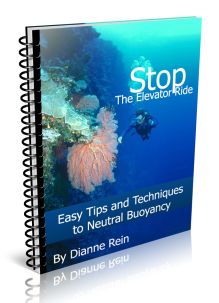
For even more in-depth tips on attaining neutral buoyancy, check out our Special Report "Stop The Elevator Ride". Click here for all the details.
And here are more of our scuba diving tips you can check out:
Quick Video Tips on Air Consumption
Quick Video Tips on Buoyancy Control
Be Confident, Not Intimidated, On The Dive Boat
Click Here for a Complete List of all our Scuba Diving Tips
What's New


-
Unofficially Summer
May 25, 24 07:19 AM
Well it is finally here. Memorial Day weekend and the unofficial start of summer! Wishing everyone a happy and healthy holiday weekend. Hopefully the weather cooperates wherever you are and you will b… -
Happy New Year
Jan 01, 24 06:00 AM
Happy New Year everyone! I hope everyone is well and had a fun New Years Eve! May your new year be filled with lots of wonderful dives. All the best to you and yours in 2024! Let the dives begin. -
Happy Holidays
Dec 14, 23 05:05 AM
I hope everyone is enjoying the holiday season! I am always amazed at how fast time flies and another year is just around the corner. I wanted to pop in and say hi to everyone. I am doing some full ti… -
3 Common Scuba Diving Mistakes New Divers Make
Feb 23, 23 02:18 PM
 In this video, I share 3 common scuba diving mistakes beginner divers make. Learn how to correct these for a better - and safer - dive.
 -
Scuba Diving Tipping Etiquette: How Much And When To Tip Scuba Crew
Feb 06, 23 03:34 PM
Not sure of scuba diving tipping etiquette? In this video I share who to tip, when to tip, how much to tip, tipping on liveaboards, tipping an instructor & more
Click below to grab our free report and weekly actionable tips:

Popular Pages
 |
 |
 |
 |
New! Comments
Have your say about what you just read! Leave me a comment in the box below.