Scuba Turks and Caicos:
Review of Diving in Provo And West Caicos - Plus Information to Help You Plan Your Vacation
If you get a chance to scuba in the Turks and Caicos, grab it.
Why? How about pristine dive sites, great visibility, a gorgeous 12 mile beach and easy access from the US? It's a trip I'm sure you won't regret.
We have gone there several times and have always enjoyed it. And we will be back. There is one bad thing about the Turks and Caicos though.
It is not cheap.
So if you are looking for a cheap dive vacation, I would suggest you look elsewhere (Roatan comes immediately to mind).
However if you don't mind opening up your wallet a bit, there is a lot to like about the Turks and Caicos and the diving there.
Lay of the Land
Turks and Caicos consists of 40 different islands and cayes, only 8 of which are inhabited. The chain is comprised of two groups of islands separated by the 22 mile wide Columbus Passage.
This deep passage is a major transit line for migrating spotted eagle rays, manta rays, turtles and dolphins. On the West side of the passage is the Caicos group: West Caicos, Providenciales, North Caicos, Middle Caicos, East Caicos and South Caicos.
On the East is the Turks group: Grand Turk and Salt Cay.
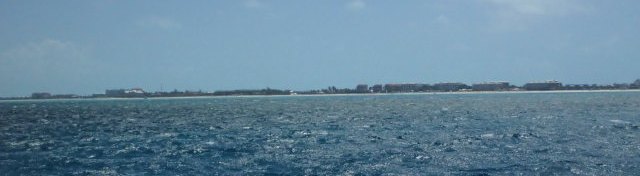
You can see how flat the island is. This is Provo and Grace Bay as we approach on a sailboat (last time we were there it was during our Caribbean sailing/diving trip)
Most of the islands are relatively flat and surrounded by shallow sandy flats. The islands themselves have many marshes and mangrove swamps which attract birds such as great blue herons, flamingos, osprey, pelicans, boobies and other water birds.
The most developed island is Providenciales (commonly known as "Provo") with a population of around 23,000. This is where most of the tourists go and it offers many hotels, restaurants, attractions, etc.
We have only stayed on Provo when we went to scuba in the Turks and Caicos - but we are working on it! Another scuba dive vacation to T&C sounds good to me.
I would love to get over to Grand Turk, but that's a story for another day.
Provo itself covers 38 square miles and is fringed by white sand beaches. It lies on the west side of the Caicos archipelago. The south part of the island faces the Caicos Bank which is a shallow part of the sea where you will find swamp and tidal flats.
Like the other islands in the chain, Provo is relatively flat with some small rolling hills.
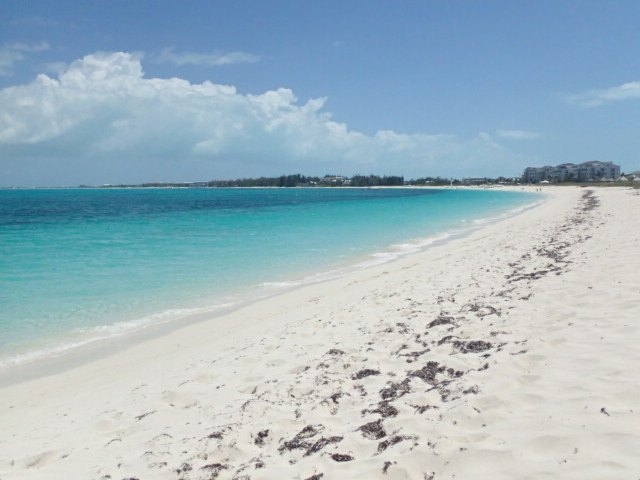
This is Grace Bay Beach. We spent many hours here. Can you blame us?
It is also home to the absolutely gorgeous Grace Bay Beach, voted the Best Beach by Conde Nast. Is it any wonder that Oprah and lots of other celebs have shown up?
Most people stay on Grace Bay Beach and do alot of diving off its shore.
Location
The Turks and Caicos are located just south (30 miles) of the Bahamas and 575 miles southeast of Miami. It is a short 1 1/2 hour plane ride from Miami. Probably a big reason there is so much development going on in these islands.
You can check their location out on our page of maps of the Turks and Caicos
Flights to Turks and Caicos
It is easy to get to the Turk and Caicos with many direct flights from the states, especially during the high season (mid-December through April).
Whether you are coming from the US, Europe or other points, find general info on getting to T&C on our flights to Providenciales page.
You'll find which airlines fly there, where you can get a nonstop flight, the airlines schedule and what we recommend to get the cheapest airfare to the Turks and Caicos.
(You might want to check out our #1 tip for cheap airfare to the Caribbean as well as our other tips for cheap airfare to help make your trip more affordable. You may also find our discussion on different types of scuba dive vacations helpful also.)
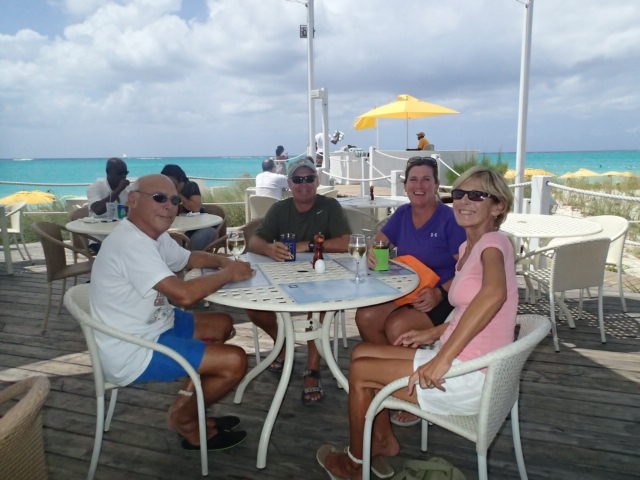
Enjoying a cocktail on Provo with some friends after diving off of West Caicos.
Turks and Caicos Hotels
With all the development going on, there are a lot of accommodations to choose from in the Turks & Caicos.
While it is not the cheapest of the Caribbean islands (by any means), you should still be able to find a hotel or resort to fit your budget.
Of course, if you are on a luxury budget (lucky you!), the sky is the limit. You will have quite a few Turks and Caicos resorts to choose from.
We have been to the Turks and Caicos twice and stayed on Providenciales both times. This is where most of the tourists go so you will have alot of Providenciales hotels to choose from.
And who can blame the tourists for flocking to Providenciales once you get a glimpse of beautiful Grace Bay and that turquoise water?
When we first went to Provo, we stayed at Beaches Turks and Cacios Resort. At that time, the resort was newly opened and we got a great price.
If you are not familiar with Beaches, it is an all-inclusive resort on Turks and Caicos and it is a higher end resort. Another way of putting it - it is pricey.
Since we have been there, it has expanded greatly and, of course, the price has gone up similarly. The expansion included alot of kid friendly additions so it has a reputation as a great place for a family vacation.
But if this is out of your price range or not your cup of tea, there are alot of other choices for you. You can check out this list of Provo hotels for one that might meet your needs.
The second time we stayed in the Turks & Caicos we stayed on my sister-in-laws sailboat. It was wonderful but not available for rent :)
Another idea would be to look for an apartment or condo to rent. I This might help you save money as you could buy food and cook yourself instead of going out for all those restaurant meals.
Airbnb and VRBO are two popular options if you choose to go the apartment/condo route. I admit I love Airbnb and use it often. For lots of trips for us, it is so much better than a hotel room and for a comparable price. If you want to give it a try, you can use this link to get $40 in travel credit when you sign up (Note: I will get $20 if you complete a trip after signing up. However I truly do love Airbnb and use it extensively both as a guest and as a host.)
Weather
Winter temperatures average a pleasant 75-80 degrees during the day and cool down to the mid-60's in the evening. Daytime temperatures warm up to 90-95 degrees in the summer with nighttime in the cooler 73-77 degree range. Summer can get hot and humid, like the rest of the Caribbean.
The rainy season goes from late May through November. We went in September during one of our trips to scuba in the Turks and Caicos. It was pretty rainy the whole time but that's the luck of the draw. Hopefully you'll have better luck if you go in September.
The last time we went we were there in April and had beautiful weather.
Hurricane season, like the rest of the Caribbean, is from June 1 to November 30. The most active period for the islands is usually September and October. The last major damage sustained in a hurricane in the Turks & Caicos was in September 2008 when Hurricane Ike hit. Hurricane Irene passed just south in August 2011.
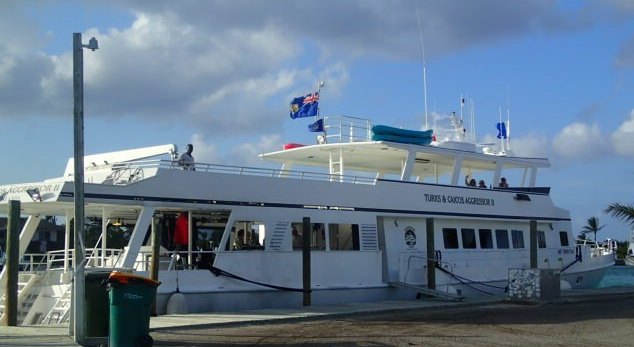
The Turks and Caicos Aggressor liveaboard dive boat docked at the same marina as us. I talked to some of the divers on board and they raved about their experience.
Water Temperature
Water temperatures range from 74F to 78F in the winter and around 80F to 84F in the summer. Most divers wear at least a shorty diving wetsuit in the winter to scuba in the Turks and Caicos.
When we dove in April, we just wore a skin and were fine. However, we don't tend to get very cold so don't go by us. Most people on the boat had on wetsuits.
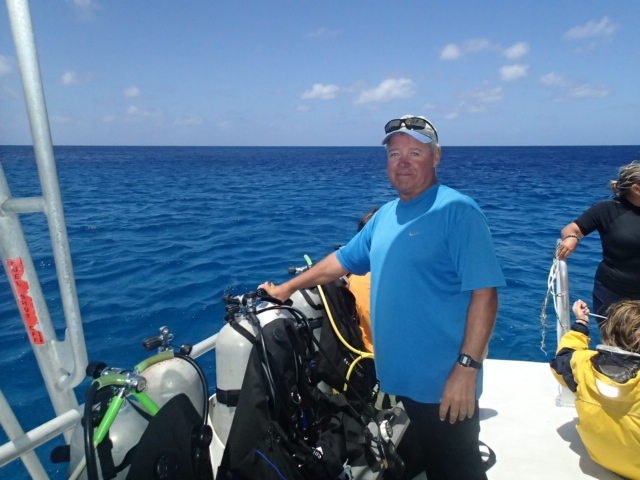
Tim taking a break after diving off of West Caicos with Dive Provo.
Scuba Turks and Caicos
The reef system here is 200 miles long and about 65 miles wide so there are lots of dive sties to explore.
Wall diving starts fairly shallow so it is also good for beginners. Some drop offs start as shallow as 35-40 feet. If you are a beginner, I wouldn't hesitate to recommend scuba Turks and Caicos as a great place to get your feet wet.
Marine parks and fishing reserves have been set up in the islands. The Princess Alexandra National Park is off the coast of Provo and most diving off of Grace Bay is done within the boundaries of the park.
No commercial or sport fishing is allowed within the park. Mooring balls have also been set up at most of the sights throughout the islands to protect the coral.
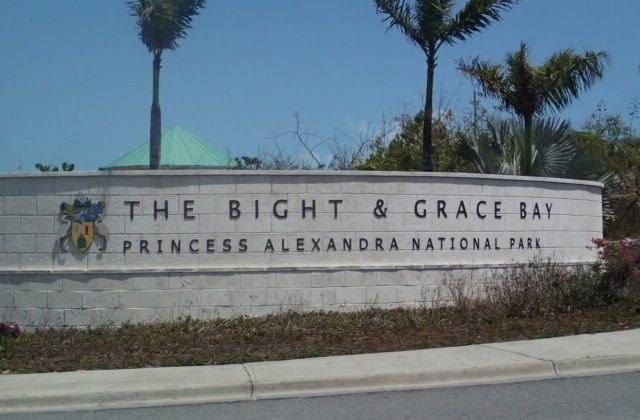
Main entrance to Grace Bay on Provo.
If you are diving off of Grace Bay, the reef is located close to shore. No hour long boat rides here - a definite advantage of scuba in the Turks and Caicos.
Our rides to the sites off of Grace bay were about 15-20 minutes.
The last time we were there, most of our diving was done off of West Caicos. The seas were rough in front of Beaches Resort where we were staying, and West Caicos offered a more protected area.
This meant we had to take a van across the island to the dive boat. But since it was only about a 5 minute ride across the island, it wasn't too bad. Of course, how could I ever complain when I get to scuba in the Turks and Caicos?
The boat rides out and back to West Caicos were about 45-60 minutes.
Even when the weather wasn't that great, we still had good visibility. It is not unusual to have visibility in the 100+ feet range.
We would rate the diving here as very good. There are some beautiful coral formation and a variety of marine life.
Turks and Caicos, like the rest of the Caribbean, has been affected by the lionfish invasion, warmer water temperatures, hurricane damage, etc. However, the diving is still very nice and I think it is definitely worth a trip.
You can read more about diving and dive sites in the Turks and Caicos here.
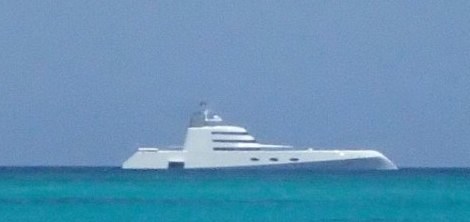
Nothing to do with diving but this boat was so unusual I wanted to share. This is the private 300+ foot "Motoryacht A" owned by a Russian billionaire. It was anchored off of T&C while we were there. Amazing.
A couple dive stories from our experiences of scuba in the Turks and Caicos:
The Masked Captain
On one boat ride out to West Caicos, there were 8 of us huddled in front of the boat. We were trying to escape the squall that hit us.
We were cold. And wet. One of the divers pipes up, "We are doing this for fun, right?"
Then the boat stopped. The captain came down.
In full yellow rain gear. And his diving mask on.
You can't make this stuff up.
We were getting close to the reef and he couldn't see. So we waited out the squall.
The squall passed and we finally got to scuba in the Turks and Caicos.
What is that floating past?
We were doing our safety stop after a dive off of West Caicos. I am looking around and see something strange. Couldn't figure out what is was at first.
Then it was obvious.
The mooring had broken. A piece of the concrete holding the mooring ball was floating past. With the dive boat attached. And heading right for my brother in law's head.
After some quick underwater pantomime, we were able to get him out of the way before he was wonked on the head. And thankfully there was a captain on the runaway boat. Otherwise it would have gone straight onto shore at West Caicos. No harm done.
At least it makes for a good dive tale over a few cold ones!
Topside
By far, our favorite thing to do after we finish checking out some dive sites on Provo is to walk Grace Bay Beach. The beach is gorgeous with powder soft sand and the water is a beautiful turquoise blue.
A relaxing walk along Grace Bay is perfect after you scuba in the Turks and Caicos.
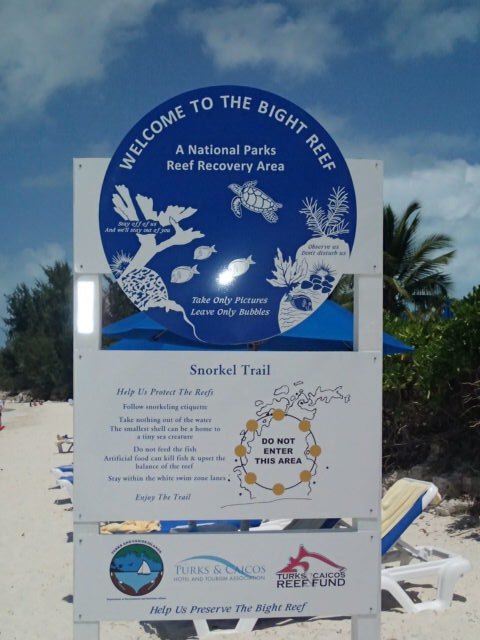
There is a snorkel trail right off of Grace Bay with tiles underwater identifying highlights and various coral formations. Nice for a non-diver too.
If you are lucky, you may get to see JoJo, the resident wild Atlantic bottlenose dolphin, playing in the water. JoJo has been living and playing in off of the Turks and Caicos Islands since 1980.
He is one of the few dolphins around the world that voluntarily interacts with human beings in his own natural habitat. The government has proclaimed JoJo a National Treasure, with a specially appointed warden to protect him.
We got to see JoJo once during a trip to scuba in the Turks and Caicos. He followed the dive boat out from shore and was playing in the waves created by the boat. Unfortunately, we didn't get to dive in and play with him. Maybe next time.
So go do some scuba in the Turks and Caicos. You won't regret it.
For more information, take a look at our other pages on Turks and Caicos:
Turks and Caicos Dive Sites //Maps of Turks and Caicos //Turks and Caicos Hotels//Turks and Caicos Flights
You might also want find these books helpful while planning your vacation to the Turks and Caicos:
Want to stay down longer and improve your buoyancy control and other diving skills? Our free report "Increase Your Bottom Time" along with our practical, weekly actionable tips will have you looking like a seasoned diver in no time. So come join us and see improvement on your very next dive!
(Click on the photo to join us now!)

What's New


-
Happy New Year
Jan 01, 24 06:00 AM
Happy New Year everyone! I hope everyone is well and had a fun New Years Eve! May your new year be filled with lots of wonderful dives. All the best to you and yours in 2024! Let the dives begin. -
Happy Holidays
Dec 14, 23 05:05 AM
I hope everyone is enjoying the holiday season! I am always amazed at how fast time flies and another year is just around the corner. I wanted to pop in and say hi to everyone. I am doing some full ti… -
3 Common Scuba Diving Mistakes New Divers Make
Feb 23, 23 02:18 PM
 In this video, I share 3 common scuba diving mistakes beginner divers make. Learn how to correct these for a better - and safer - dive.
 -
Scuba Diving Tipping Etiquette: How Much And When To Tip Scuba Crew
Feb 06, 23 03:34 PM
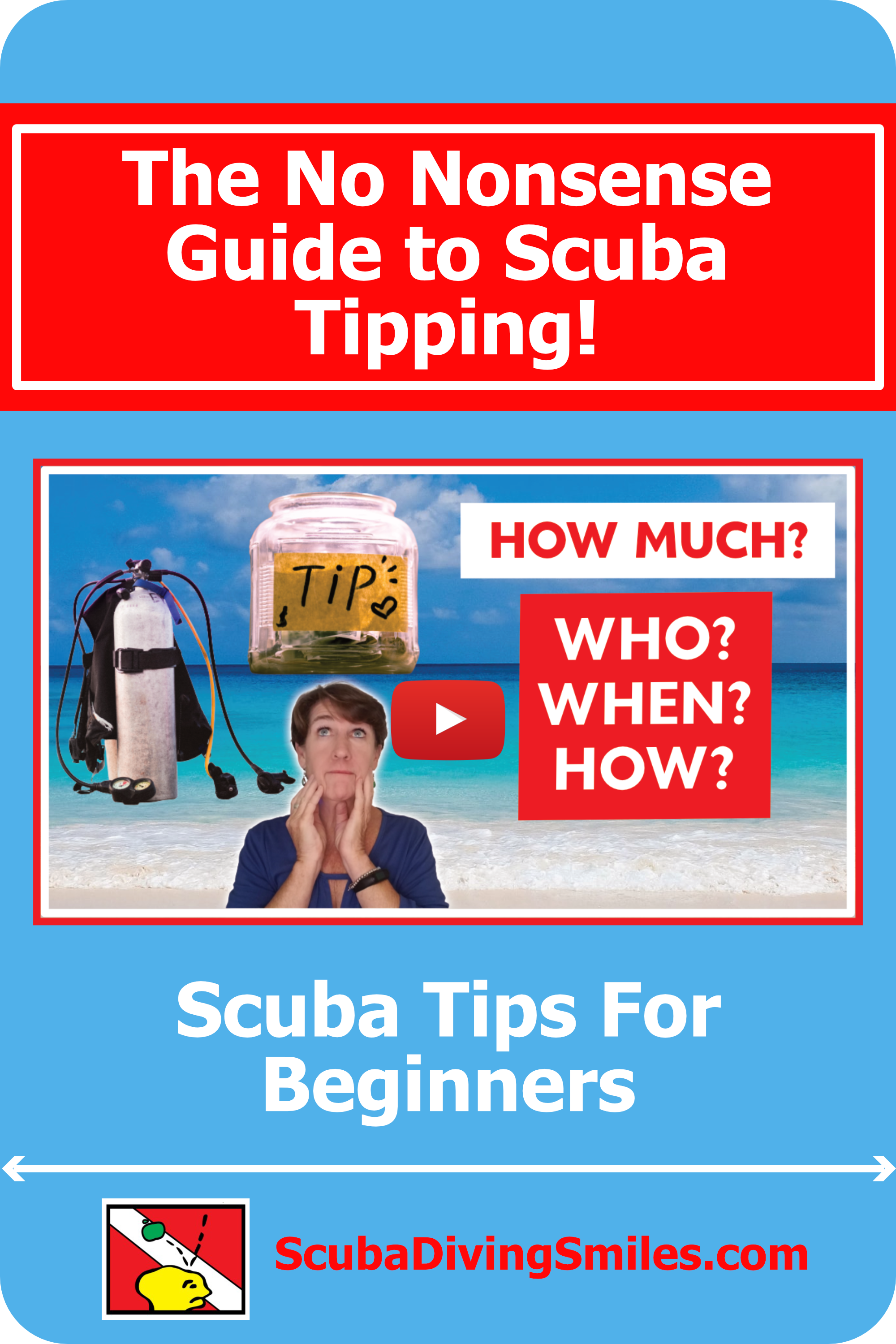 Not sure of scuba diving tipping etiquette? In this video I share who to tip, when to tip, how much to tip, tipping on liveaboards, tipping an instructor & more
 -
Scuba Diving Tips For First Time
Jan 29, 23 05:41 PM
 These scuba diving tips for first time divers will help improve buoyancy control, air consumption, equalization and boat diving. Improve on your very next dive!
Click below to grab our free report and weekly actionable tips:

Popular Pages
 |
 |
 |
 |



Recent Articles
-
Happy New Year
Jan 01, 24 06:00 AM
Happy New Year everyone! I hope everyone is well and had a fun New Years Eve! May your new year be filled with lots of wonderful dives. All the best to you and yours in 2024! Let the dives begin. -
Happy Holidays
Dec 14, 23 05:05 AM
I hope everyone is enjoying the holiday season! I am always amazed at how fast time flies and another year is just around the corner. I wanted to pop in and say hi to everyone. I am doing some full ti… -
3 Common Scuba Diving Mistakes New Divers Make
Feb 23, 23 02:18 PM
In this video, I share 3 common scuba diving mistakes beginner divers make. Learn how to correct these for a better - and safer - dive.
New! Comments
Have your say about what you just read! Leave me a comment in the box below.